
Wood Waste Valorization and Classification Approaches: A systematic review
Research Paper
This systematic literature review delves into various wood waste valorization and classification approaches, aiming to evaluate their efficacy in fostering sustainable wood resource management while enhancing the economic value of wood waste.
A Conceptual Framework for the Upcycling Supply Chain in the Wood Sector
Research Paper
This paper highlights the importance of sustainable practices in supply chain management, focusing on upcycling as a key approach to transforming discarded materials into valuable products.
Steam Explosion: A Booster for Fungal Growth in a Myco-composite
Research Article
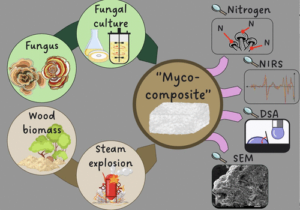
This study investigates steam explosion pretreatment to enhance the growth of Trametes versicolor on beechwood, with optimal growth observed at a severity (logR₀) ≤ 3.96.
Mycelium density and heterogeneity were characterised using SEM, nitrogen analysis, and NIRS combined with multivariate methods. The results demonstrate a reliable approach to quantify fungal density and enable multicriteria optimisation of fungal–matrix combinations for tailored myco-composite properties.
Cell Wall Chemical and Structural Changes of Wood by Steam Explosion to Increase Fungal Growth for Myco-Composite Production
Research Article
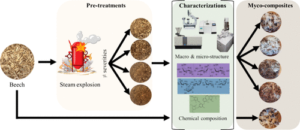
This study shows how steam explosion pretreatment can significantly improve the conversion of wood waste into myco-composites by enhancing fungal growth on beech wood. By identifying an optimal pretreatment window, the research demonstrates how modifying wood structure and chemistry makes substrates more accessible to fungi while avoiding growth inhibition. The findings highlight a practical pathway to turn lignocellulosic residues into high-performance, bio-based materials.
CEPS Report
Improving waste wood circularity in the EU: classification frameworks and policy options
CEPS paper on DPPs
How digital product passports can enhance waste wood valorisation and circularity in the EU
This CEPS In-Depth Analysis explores the challenges and opportunities for advancing waste wood valorisation and the circular economy using Digital Product Passports (DPPs). After consulting with experts, some of the challenges and opportunities identified include data availability, access and integration; harmonised DPP content; limited stakeholder capacity; and the costs of implementing DPPs.

Deliverable 4.3
Recycled Wood Cascade Valorisation Framework
The study comprehensively outlines the various wood valorisation approaches currently available, alongside additional aspects that were researched and analysed for effective framework design and development.

Deliverable 4.4
Data sharing model, FAIR digital assets and digital passports principles
Deliverable 4.4 creates a digital infrastructure for sustainable wood recycling via a Data Sharing Model (DSM) built on FAIR principles and Digital Product Passports (DPP). This work package enables transparency and traceability, setting the stage for DPPs and circular tools to ensure high-quality, sustainable wood management.

Deliverable 4.5
How do we measure the real impact of circular solutions in our project?
By establishing key performance indicators (KPIs) and digital tools, we will evaluate the results from implementing the W2W wood waste cascade valorisation upcycling framework in the 3 Use Cases (circular solutions).
💡Deliverable 4.5 - "Definition of impact assessment methodologies and KPIs" - does just that!

Deliverable 5.1
CDW flows valorisation and digitalisation (version 1)
This deliverable provides the first analytical application of a digital Material Flow Analysis
(MFA) tool developed to support circular management of Construction and Demolition Waste (CDW), with a specific focus on wood materials.
Deliverable 5.2
Wood and glass non-destructive real time techniques analysis & optimal size definition (version 1)
This report summarises the activities and key outcomes of Task 5.2 – “Wood and glass non-destructive real-time techniques analysis and definition of optimal size”, under Work Package
5 (WP5).
Deliverable 5.3
Adaptive glass and wood sorting systems (version 1)
This deliverable describes the technical design of the system aiming to sort wood and glass waste streams, as they arise from construction demolition waste (CDW).
Deliverable 5.4
Better Separation and Quality Control Systems (version 1)
The ‘advanced separation and sorting technologies’ component of W2W includes a collaborative picking line comprising a conveyor along which human workers collaborate with robotic systems in order to ensure the sorting quality.
Deliverable 7.1
Cascade to function, mixed wood treatment
Task 7.1 is focused on the production of fillers from waste wood to enhance the durability and performance of the PLA- biocomposites. The results showed the feasibility of obtaining nanofillers (cellulose nanofibers and lignin) from waste wood.
Deliverable 7.2
New mix between wood, glass and composites for wallboards
This deliverable includes the developments regarding Task 7.2: New mix between wood, glass and composites for wallboards (Μ08-Μ18).
Deliverable 7.3
Final products and initial validation
This deliverable focuses on developing and validating prefabricated façade systems that incorporate PLA-based composite panels in off-site building envelope manufacturing.
Deliverable 9.1
Glue separation from wood and bioremediation wood treatment
This report presents the progress and results of Work Package 9 (WP9), focusing on two key innovations: the separation of glues from wood using steam explosion (SE) technology and the
bioremediation of wood effluents through fungal treatment.
Deliverable 9.2
Liquefaction process of mixed wood waste
Task 9.3 focuses on the synthesis of bio-polyols and the development of non-isocyanate polyurethanes (NIPUs) using waste wood and derived lignin as feedstock.
Deliverable 9.3
Glue separation from wood and bioremediation wood treatment
This report focuses on Use Case 2, which explores the application of steam explosion (SE) and fungal bioremediation to remove contaminants from BR1/BR2 wood waste and repurpose it into high-performance, environmental-friendly materials.
Deliverable 11.2
Valorisation of ashes from CDW and thermal gasification (version 1
The objective of this task is to transform biomass-derived fly ashes, which contain toxic heavy metals and persistent organic pollutants, into stabilized aluminosilicate structures using microwave-assisted hydrothermal treatment.
Deliverable 11.5
Assessment of dodecanol and validation of detergent formulations (version 1)
This deliverable presents the experimental outcomes of Tasks 11.5, which focus on a preliminary
assessment of compatibility of the product obtained from Kiverdi in Task 11.4 (target Dodecanol
from fermentation) with surfactants formulation and provide feedback to Kiverdi for process fine tuning in D11.5.
Deliverable 13.1
End-to-end tracing module and DPP
This deliverable presents the design, development, and preliminary implementation of the End-to-End Tracing Module and Digital Product Passport (DPP) toolkit developed within the W2W project.
Deliverable 13.2
Material Volume Estimation Tool (version 1)
The deliverable documents the development progress of the Material Volume Estimation Tool that allows the monitoring of wood waste material generated in construction sites and ends up to sorting facilities. This first version provides an overview of the frontend and the backend of the wood waste monitor.
Deliverable 13.3
Supply chain optimisation tool
This is the first version of a SCO (Supply Chain Optimisation Toolkit) to help companies in the wood industry create more sustainable and efficient supply chains. This web-based platform addresses the urgent need for circular wood practices in the construction and furniture industries across Europe.
Deliverable 13.4
Life cycle analysis computation tool (version 1)
Deliverable D13.4 is an overview of the Version 1 of the W2W Life Cycle
Sustainability Assessment (LCSA) tool. This tool supports the broader
objectives of the W2W project by enabling multi-dimensional sustainability assessment of cascade valorisation pathways for wood materials.
Deliverable 13.5
Integrated Circular Wood Upcycling Platform (version 1)
The deliverable outlines the first version of the Integrated Circular Wood Upcycling Platform. The platform acts as the central digital hub, bringing together key tools that support circular wood management—such as supply chain optimisation, life cycle analysis, digital product passports, and material volume estimation.
Deliverable 16.1
Maturity Index and Scenarios on twin transition trends and occupational scenarios for European labour market in circular economy in the process industries by 2035
This deliverable presents the findings of Task 16.1 of the Wood2Wood (W2W) project, focusing on the identification of trends and the development of future scenarios for employment and skills in Europe’s wood cascading process industries. The objective is to anticipate how labour market
dynamics may evolve by 2035 under the influence of the twin green and digital transitions and the
increasing adoption of circular economy practices.

Deliverable 16.2
Skills activities, trainings and lifelong learning programmes
This deliverable is part of Work Package 16 and focuses specifically on the People dimension of the 6Ps methodology, aiming to enhance workforce capabilities in alignment with the evolving demands of digital transformation. Emphasis is placed on the identification of emerging job profiles, the mapping of critical competencies, and the formulation of targeted training interventions that support the upskilling and reskilling of professionals across multiple use cases.
Deliverable 16.3
Standardisation activities (version 1)
The purpose of this deliverable is to provide information on the standardization landscape and applicable standards relevant for W2W project.
Deliverable 16.4
Policy recommendations for developing a circular and sustainable process industry (version 1)
The report explores challenges and opportunities for advancing waste wood valorisation and the circular economy through the use of DPPs. Combining desk research on opportunities and challenges for waste wood valorisation with the use of DPPs with expert consultations, the report finds challenges and opportunities relating to data availability, access, and integration; harmonised DPP content; limited stakeholder capacity; and the costs of DPP implementation.

Deliverable 19.1
Communication and Dissemination Plan and Activities
This document
outlines the Wood2Wood consortium’s Communication and Dissemination strategy, giving necessary guidelines for the project
partners on how to share deliverables generated by the project effectively throughout its
duration.

Deliverable 19.2
Exploitation and Business Innovation Plan
This deliverable will provide a comprehensive roadmap for the overall project exploitation management over the entire reporting period, ensuring that the project's outcomes
are effectively utilised and contribute to the project's overall impact.
Deliverable 19.3
Synergies with relevant initiatives and best practises exchange (version 1)
This deliverable aims to provide a detailed overview of collaboration activities and how they contribute to the project’s objectives and also to serve as a reference for future collaboration opportunities.
Deliverable 19.5
Market analysis, business models and revenue streams (version 1)
The deliverable aims
to understand and analyse the prospective markets targeted by the circular technologies of W2W project, as well as build and present the initial version of the business models for the respective technologies.

Press Release #3: What are the future roles for the labour force in a circular economy?
Climate change, inconsistent policies, greenwashing concerns and the promise of AI-powered sorting systems are reshaping how the wood sector must adapt.
The Wood2Wood (W2W) project is addressing a structural blind spot in circular economy transitions: the future occupations needed to make wood reuse viable at scale.
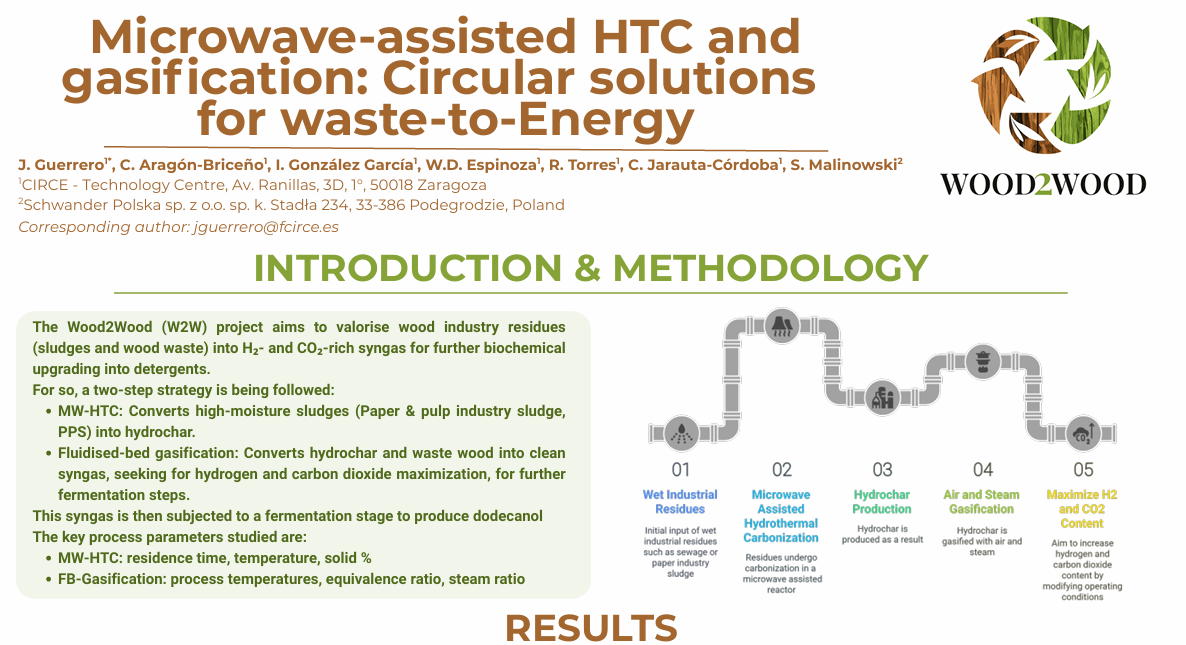
Microwave-assisted HTC and gasification: Circular solutions for waste-to-Energy
The Wood2Wood (W2W) project aims to valorise wood industry residues (sludges and wood waste) into H₂- and CO₂-rich syngas for further biochemical upgrading into detergents.
One of the main conclusions is that a cascade valorisation approach combining MW-HTC and gasification is viable for treating moist wood industry residues.
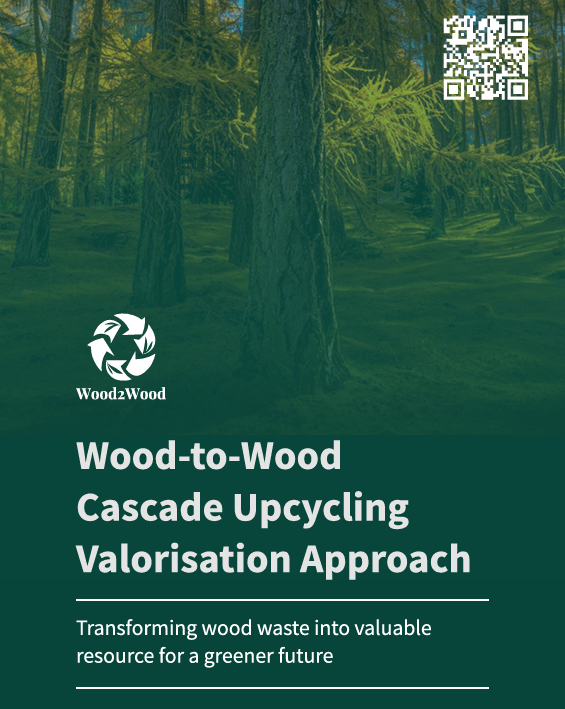
Latest W2W Brochure
Ahead of Ecomondo, the Green Technology Expo in Rimini, Italy, Wood2Wood created a brochure for display at the ISWA booth and during the EU Projects workshop with three other Horizon Europe projects: EcoRefibre, Grinner and Reclaim. The purpose of the workshop was to exchange technical knowledge between the four projects to identify synergies and explore future collaboration potential.
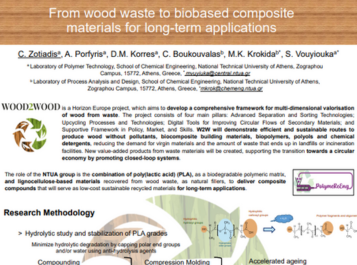
W2W at Polymers 2024 Conference
National Technical University of Athens presented research methodology on developing biobased composite materials at Polymers 2024 Conference Sciforum. From wood waste, NTUA aims to deliver biobased composite materials that will serve as low-cost sustainable, recycled materials for long-term applications, adhering to close-loop principles in a circular economy.
Press Release #2
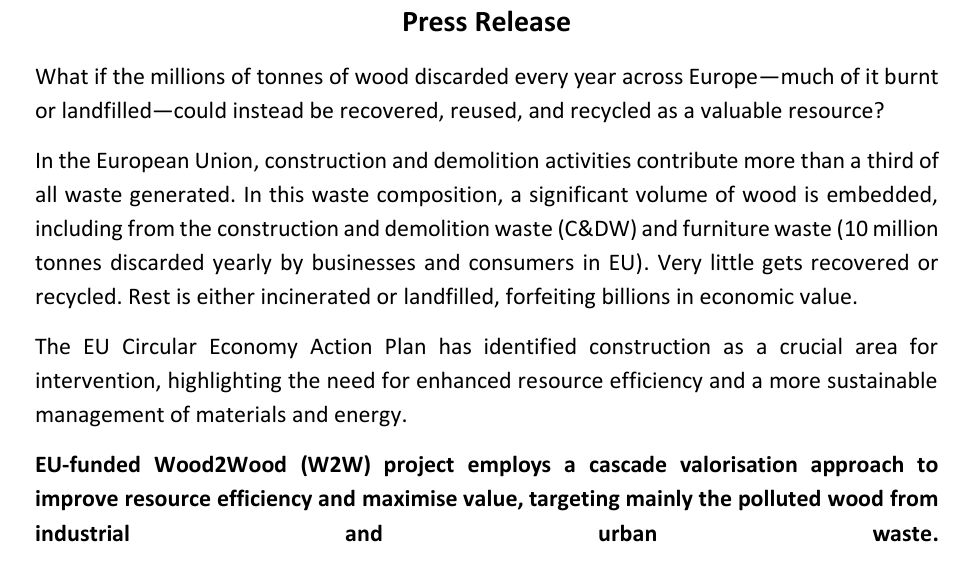
What if the millions of tonnes of wood discarded every year across Europe—much of it burnt or landfilled—could instead be recovered, reused, and recycled as a valuable resource?
EU-funded Wood2Wood (W2W) project employs a cascade valorisation approach to improve resource efficiency and maximise value, targeting mainly the polluted wood from industrial and urban waste.
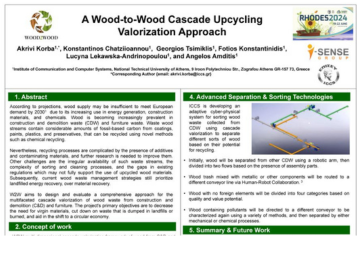
W2W framework presented at Rhodes
Last week, W2W Project was presented at the 11th International Conference on Sustainable Solid Waste Management, in Rhodes, Greece. The wood valorisation framework was highlighted in an online poster session, offering innovative insights into sustainable practices.