
Written by Abhimanyu Chakravorty
Circular Economy is more than just an environmental imperative. It is a strategic objective linked with Europe’s material sovereignty and security.
This was one of the main overarching messages at the European Circular Economy Stakeholder Platform (ECESP) annual conference in Brussels (April 22-23) that brought together diverse stakeholders to discuss the ambitions, scope and policy direction of the Circular Economy Act, which will enhance the Single Market for circular products and services.
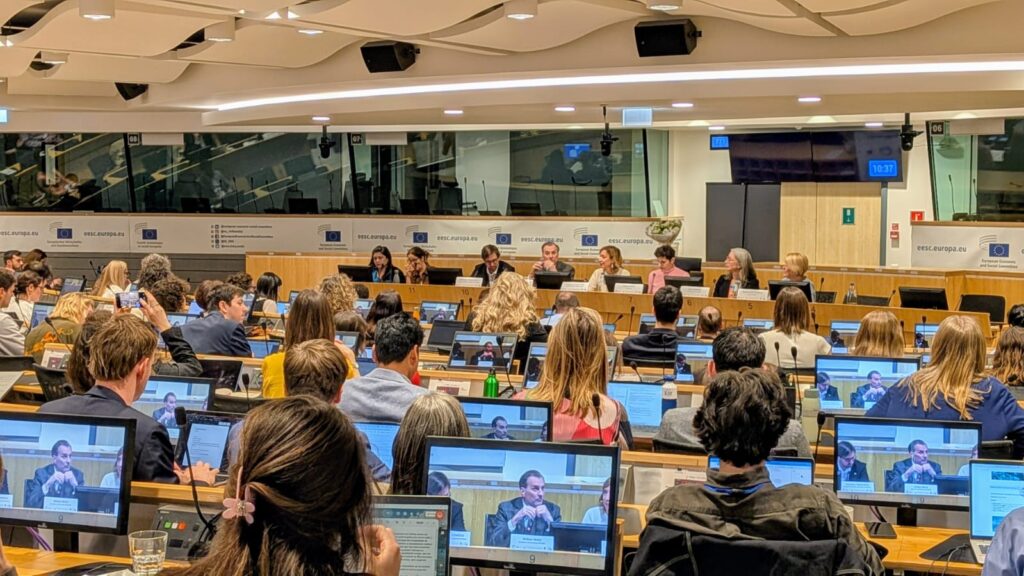
The discussions emphasised that materials are strategic, and European member states need to efficiently and effectively recover secondary materials to reuse and recycle to enhance EU’s material sovereignty and competitiveness.
Over two days, the high-level plenary sessions put the Circular Economy Act and the Single Market at the core of the ECESP conference agenda. The stakeholders underlined the urgent need to treat “Circularity as security” especially given the rapidly changing geopolitical scenario and Europe’s dependence on third countries for some strategic and critical raw materials.
As Jessika Roswall, the EU Commissioner for Environment, Water Resilience and a Competitive Circular Economy, put it, “Dependencies come with a cost.”
To increase EU strategic autonomy and strengthen material resilience, the role of the forthcoming Circular Economy Act (CEA) is essential in moving towards this direction.
The first session on “Embedding circular economy principles in the Single Market: If not now, when? The role of the forthcoming Circular Economy Act” threw open a few questions, among many, to read the room.
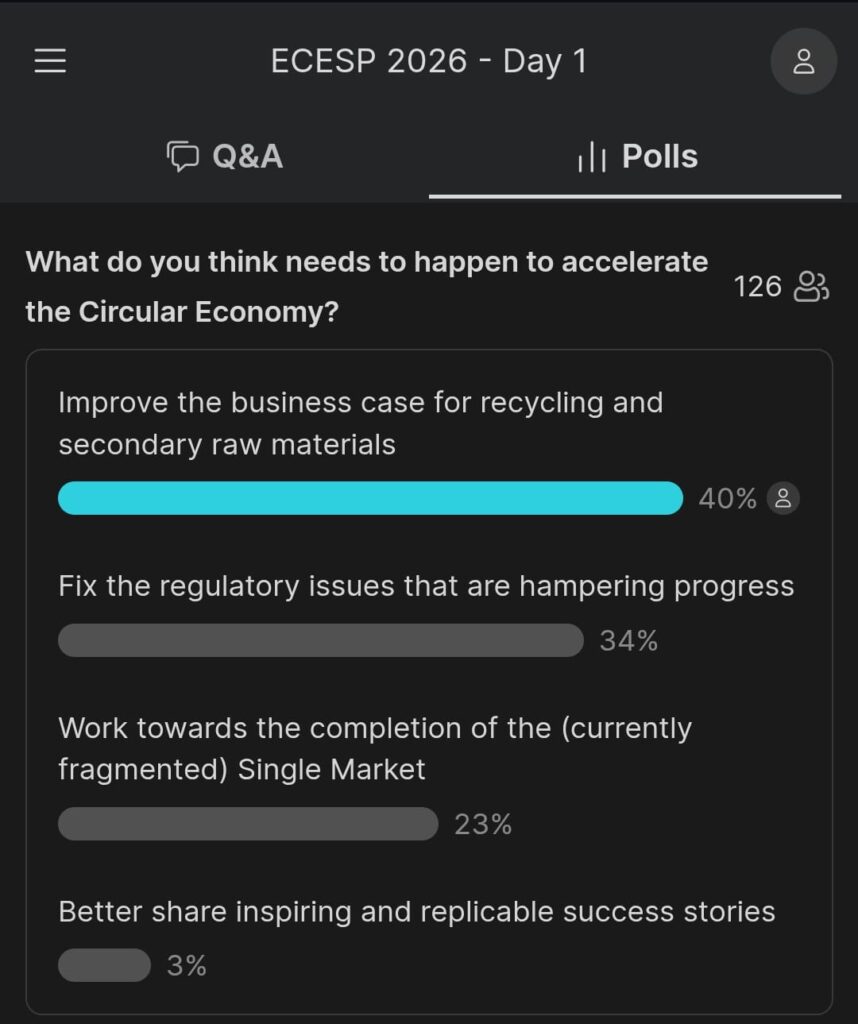
“What do you think needs to happen to accelerate the Circular Economy?” The majority said, “improve the business case for recycling and secondary raw materials”. Fixing regulatory issues that hamper progress was the second most voted answer. (Picture below)
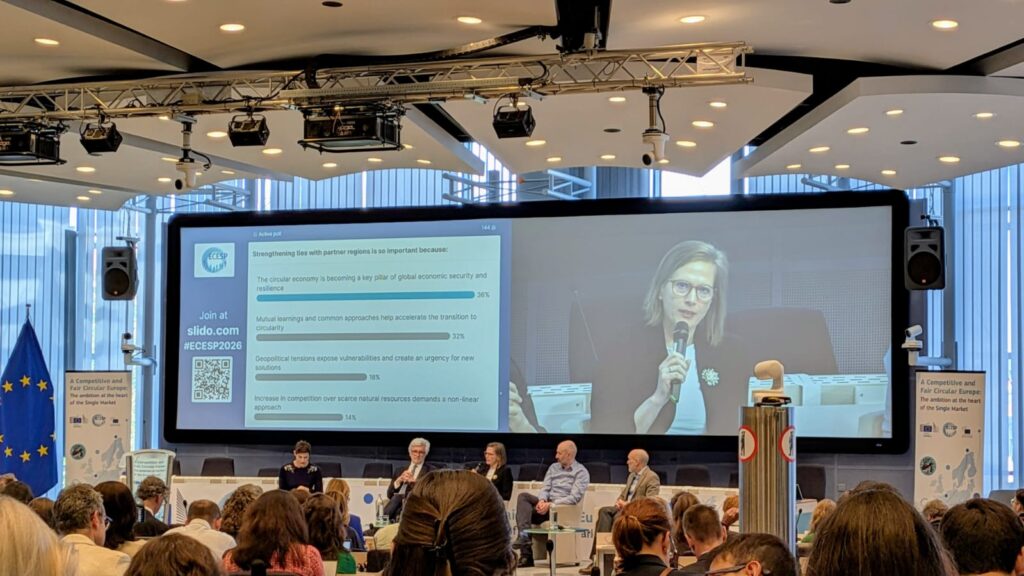
The second session on “How to strengthen ties with partner regions and learn from each other?” asked stakeholders reasons why this is important in the context of the Circular Economy Act and the Single Market in the European Union.
Stakeholders largely agreed that the “Circular Economy is becoming a key pillar of global economic security and resilience” but they also upvoted “Mutual learning and common approaches help accelerate the transition to circularity”.
Within this frame, the moderator asked “What is the role of trust in circularity?”
To this end, Veronika Hunt Safrankova, Head of Brussels office, UNEP, mentioned that sharing best practices in an open and transparent way is important, even if some parts of regulations or implementation didn’t go so well, so regions and countries can pick up and learn together and set up standards in a practical and implementable way. And predictable partnerships to put cards on the table on what works and what doesn’t.
Valere Moutarlier, Director-General for European Industry and Decarbonisation (DG GROW), emphasised on trust building between partners to support enforcement. (Picture below)
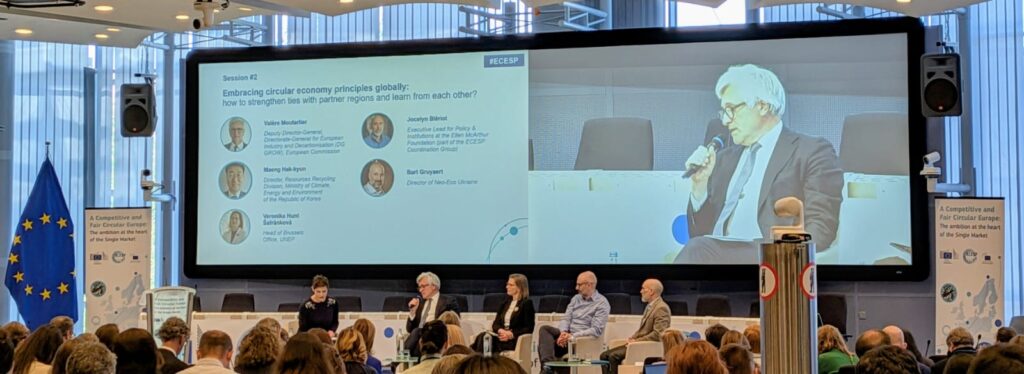
“Trust is also related to enforcement. We need partners that trust us and we can trust what they will be putting on our (European) market and expectations of what they should comply with to enter the market. Product design for certification, but also sampling, Digital Product Passports (DPPs), how we ensure the DPP is embedded in the products and to which extent it complies with standards.”
The mention of DPPs was an interesting connection with the Wood2Wood project, a Horizon Europe initiative.
Do you know that we are developing a DPP as part of an integrated digital platform to improve circular flows for secondary raw materials?
For example, the DPP will share detailed information about wood-containing product’s materials, components, and environmental impact throughout their lifecycle with relevant stakeholders.
In short, DPPs address traceability, transparency and knowledge sharing.
We were happy that the conversations at the conference broadly resonate with our project.
Then, day 2 of the conference started with a high-level opening from Aurel Ciobanu-Dordea 🇪🇺 on the role for stakeholders on the circular economy policy agenda to achieve maximum impact.
“It is a seminal period. Our agenda is populated by emergencies which we need to respond to, so such exchanges at the ECESP, yesterday and today, are important to us.”
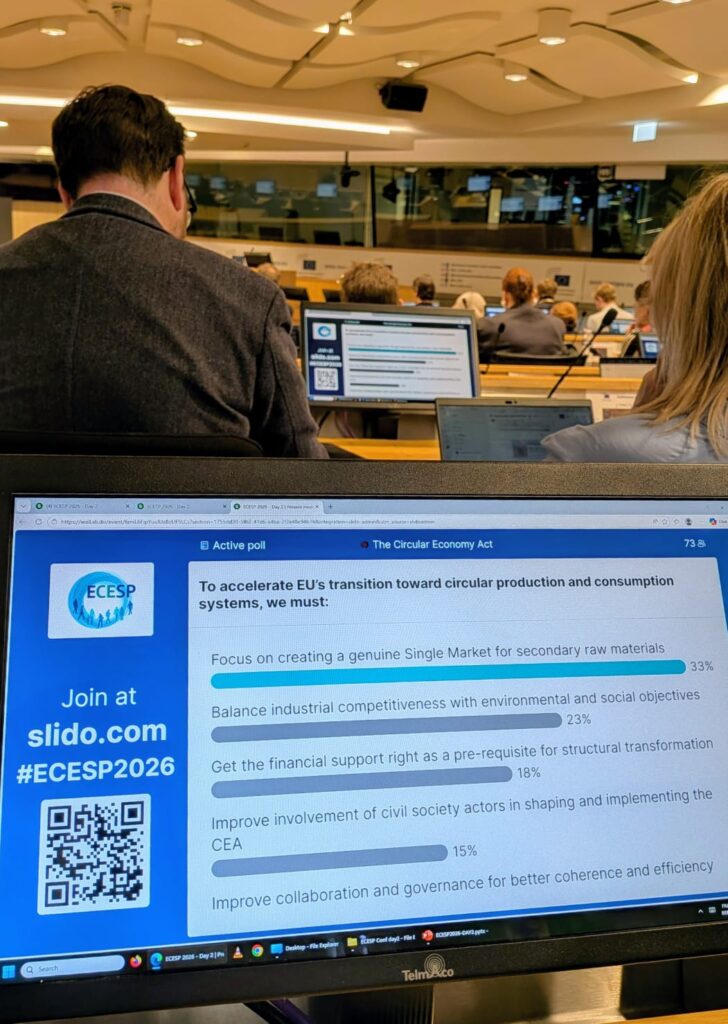
“The fact that for this year’s stakeholder platform we have the overarching title of Circular economy Act and Single Market shouldn’t obscure the fact that circularity is good for environment and resource efficiency. CE is at the crossroads of three objectives of single market, environment and resource efficiency.”
Indeed, a Circular Economy sits at this intersection of three objectives, though to ensure a CE that works in practice, we must focus on EU-wide standardisation to ensure a flow of secondary raw materials across the bloc but also take into account national differences.
This is what Eric Mamer, head of the EC’s DG Environment made very clear but cautioned against getting stuck on national differences.
“Different members states have different rules and this creates a natural barrier to the flow of secondary raw materials across EU. In CE, we are thinking about how to ensure we move much more serious to define as waste and secondary raw materials, not in one member state but across the EU.”
“I wish in the subsequent discussion in the parliament and council the focus remains the single market for Circular Economy and hope they don’t get trapped into debates on national differences. We need to take into account national specificities, but we need to ensure Europe-wide solutions to scale as much as possible,” he added.
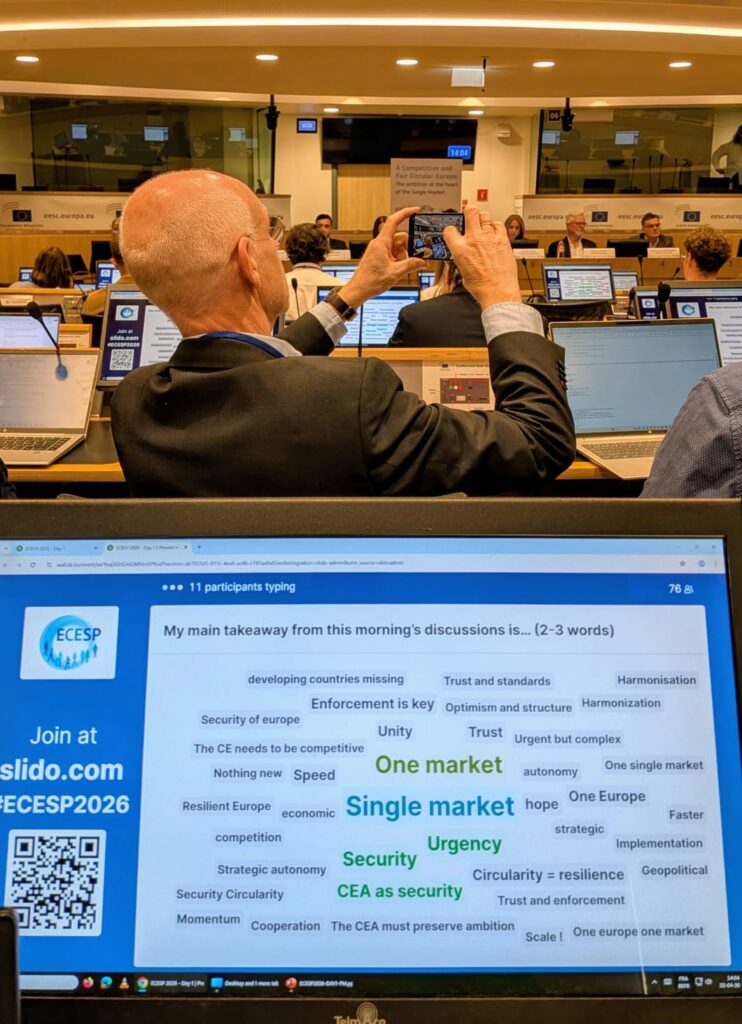
Finally, the massive finance gap in the circular economy was highlighted by Emmanuel Chapponiere, head of division at the European Investment Bank (EIB). Today, he said, the CE faces a finance gap of at least 82 billion Euros per year to decarbonise the EU’s economy.
“I don’t think capital availability is the issue but bankability of operations,” he said, adding that “you need to create the market and ensure there is enough feedstock and demand for that.”
Anna Douglas, Senior Sustainability Adviser at SEB Group, echoed Emmanuel’s perspective and added “risk is the primary driver for bankability”.
“When we look at bankability, we look at risk. Risk is the primary driver because of geopolitical disruptions and the sectors that are more prone to them, like critical minerals. We must also see the business model side and look at potentially an ecosystem response.”
To conclude, the ECESP conference brought together stakeholders driving the circular economy and put the Circular Economy Act and Single market in the center of the discussion. Some major themes emerged from the conversations: Materials are a strategic asset to the EU and security is the driver of circularity; feedstock matters to scale circular industrial base; financing gap in Circular Economy is staggering; and harmonisation in standards across EU member states to scale secondary raw material flows.
We hope that these themes are reflected in the forthcoming Circular Economy Act.