
The conversation at the webinar brought to the fore important messages, with one of them being the salient one: the circular economy skills gap is not primarily a knowledge problem – it is a system problem.
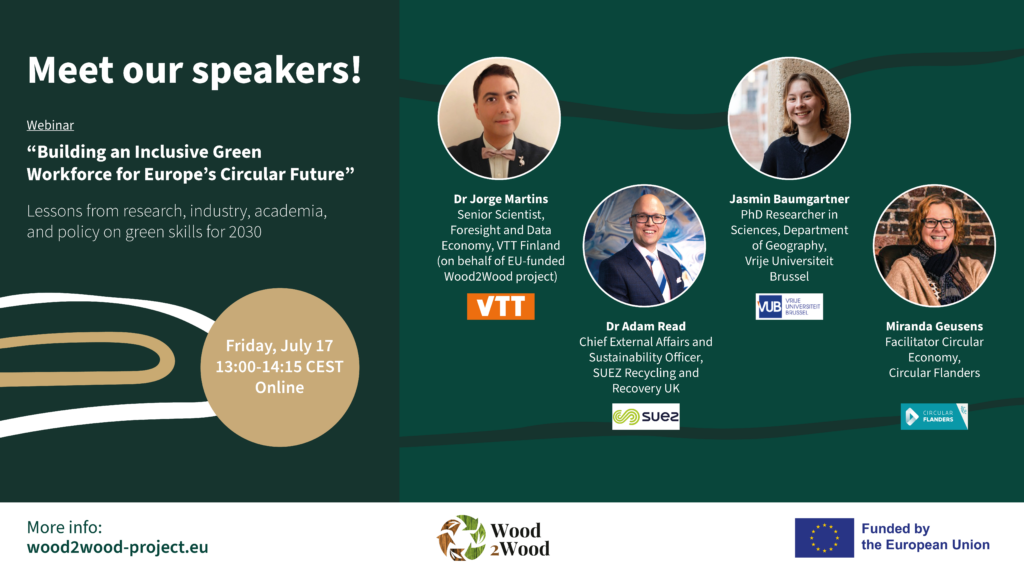
Four speakers from four different walks of life gathered together to discuss the future skills the current workforce needs by 2030 to be able to support the transition to a circular economy in Europe. Evidence shows that while employment in the environmental economy grew faster between 2000 and 2022 than in the overall economy1, the transition to a green economy also carries risks such as:
- Skills shortages are already straining businesses,
- The impacts of the transition are unlikely to be felt equally – with some sectors, regions, and workers, and in particular women, facing far greater disruption than others.
The EU policy architecture is ambitious. The European Green Deal, the Clean Industrial Deal, the Just Transition Mechanism, and instruments such as the European Social Fund Plus and the Recovery and Resilience Facility all point in the same direction. But ambition on paper does not automatically translate into workforce readiness on the ground. EU industries are navigating multiple constraints: supply chain dependencies, intensifying global competition, high energy prices, and competing investment priorities2.
The knowledge exists. The motivation exists. What is missing is the connection between policy ambition and what actually reaches workers, communities, and organisations on the ground.
First, Dr Jorge Martins, Senior Scientist at VTT Finland, who leads the skills development work in the Wood2Wood project. Jorge brought a foresight and research lens, asking not just what skills we need today, but what social values and conditions will shape the skills we need tomorrow.
Next, Dr Adam Read MBE, Chief External Affairs and Sustainability Officer at SUEZ UK, and former President of CIWM, brought the industry lens – and a frank perspective on what it actually takes to build a workforce for a sector in transition.
Then Jasmin Baumgartner, PhD researcher at the Department of Geography at Vrije Universiteit Brussels, brought the academic lens – and a focus on the workers that circular economy conversations most often overlook: those in foundational sectors who face not just a skills gap, but a much more fundamental barrier to entering the workforce at all.
And finally, Miranda Geusens, Facilitator for Circular Economy at Circular Flanders, with over thirty years at OVAM, provided the policy and regional government lens – and concrete experience of what it takes to translate circular principles into everyday professional practice at scale.
Here are some key takeaways:
- Current workforce development efforts are not keeping pace – and are not reaching those who need them most, particularly lower-skilled workers, women, and communities in regions facing the steepest disruption.
- What actually works is local, relational, and long-term – not the large-scale, short-term training initiatives that tend to attract the most funding.
- Training and education systems are not yet fit for purpose – treating circular skills as a technical add-on rather than the systemic, behavioural, and social shift the transition actually requires.
- Reaching 2030 fairly is still possible – but only if fairness is built into the design of the transition from the start, not bolted on at the end.
Here’s what transpired in the webinar: Full details below:
1. We are further in rhetoric than in readiness
Policy frameworks exist and the language of green skills is gaining traction – but the people expected to deliver the transition often face fragmented guidance, unclear career pathways, and uneven access to training. The workforce itself, in many cases, barely notices any change. Ambition on paper has not yet translated into meaningful shifts on the ground.
2. The skills gap is not just technical — it is social, relational, and behavioural
Future circular skills will be increasingly situated, hybrid, and socially embedded. The transition requires judgement, coordination, value negotiation, and the ability to work across organisational boundaries – none of which technical training alone can deliver. Confidence, shared language, and peer networks are just as important as formal qualifications.
3. What works is local, person-centred, and long-term — and it rarely gets scaled
The most effective approaches – person-centred training, trajectory counselling, collaboration between social economy enterprises and employment organisations, peer learning, and community-based circular practices – work precisely because they are embedded in real contexts. But they remain fragile, underfunded, and difficult to scale within systems designed for speed and volume rather than depth and inclusion.
4. The circular economy is competing for talent — and currently losing
As multiple sectors race toward low carbon futures, the circular economy is competing for the same green talent as energy, transport, and manufacturing – sectors that often pay more, offer clearer career paths, and are more visible to school leavers and graduates. Without deliberate investment in career visibility and sectoral identity, the circular economy will continue to play catch-up.
5. Training and education systems are not fit for purpose — yet
Current systems treat circular skills as a technical add-on rather than a fundamental shift in how we think about value, work, and economic organisation. Systemic change requires not just new course content but a rethinking of who training is designed for, how it is accredited, and how early in life sustainability values are introduced. Mapping skills needs and timelines is a critical first step that is still largely missing.
6. Inclusion means more than accessibility — it means integration
Upskilling and reskilling are necessary but not sufficient. For the workers furthest from the labour market — particularly those in foundational sectors like construction – the circular transition demands something more fundamental: integration into training and employment trajectories in the first place. The same structural barriers that excluded these workers before the transition are still in place.
7. Fairness must be built in from the start — not added on at the end
The transition will not automatically be fair. Women, lower-skilled workers, rural regions, and communities reliant on carbon-intensive industries face disproportionate disruption. A just circular transition requires protecting the physical spaces where circular work happens, directing funding toward local enterprises and founders rather than large corporations, and ensuring that those asked to change also have real agency in shaping the change.
8. 2030 is achievable — but only if we move faster and more honestly
It is 2026. Changing academic curricula takes years. Changing national school curricula takes longer. Momentum is building, but the hard work of implementation – moving from shared discourse to concrete action at the local level – has barely begun. Sharing examples, tools, and assignments across sectors and borders is one of the fastest ways to accelerate without waiting for systemic reform.
Watch the webinar recap here:
Citation list: